.png)
Moving On Is the Wrong Goal, Here's What to Aim for Instead

Updated: Jul 6
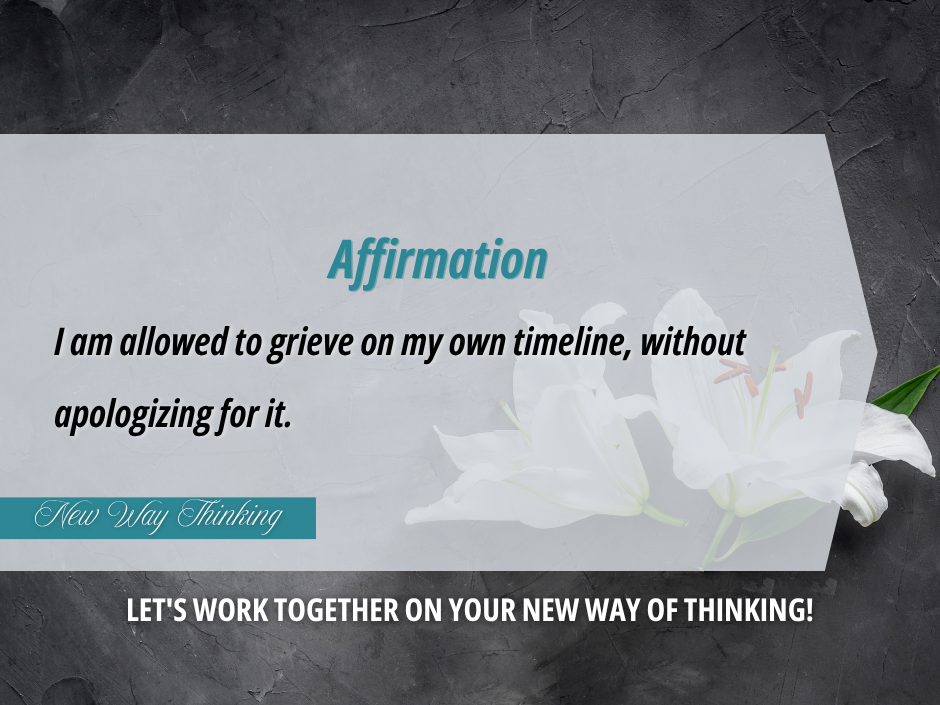
If you’re still grieving and somebody made you feel like you shouldn’t be, I want to say this before anything else. That’s a normal reaction. That’s okay. |

Somebody has probably said it to you by now. Maybe out loud, over coffee, from someone who loves you and just didn’t know what else to offer. Maybe you never heard the actual words. You just felt it. The pause after you brought them up again. The look. The sense that you were supposed to be further along than you are.
You need to move on.
Here’s what I want you to know before we go any further. Moving on was never the goal. It never was. And the pressure to hit some invisible deadline, on somebody else’s timeline, in somebody else’s words, is one of the harder things we do to people who are already hurting.
Why You Feel Like You’re Failing at This
You are probably asking yourself some version of these questions. Why can’t I just get over this? Why do I still cry at that song? Why does it still flatten me at the holidays, years later?
Those questions make sense, because we live in a culture that is deeply uncomfortable with grief. We admire people who seem to bounce back fast, and we quietly worry about the ones who don’t. There’s an expiration date nobody actually says out loud, but you’ve probably felt it anyway.
So you end up carrying two things instead of one. The loss itself, and the belief that something is wrong with you for still feeling it. I want to take the second one off your shoulders right now. You are not behind. You are not broken. You were just handed a goal that was never going to get you where you actually need to go.

What Grief Is Actually Asking of You
Grief is a normal, natural response to loss. It is not a disorder, and it is not a flaw in how you’re built. It’s what happens when you loved someone or something enough that its absence changes you.
That’s the word worth sitting with. Changes you. Grief doesn’t resolve the way a problem gets solved. It doesn’t pack up and leave once you’ve grieved correctly or long enough. It lives in you. So the real question was never how do I make this go away. It’s how do I learn to carry this and still have a full life.
There’s a shift in how grief researchers understand this now, and it matters for you. For a long time, healthy mourning meant detachment. Let go. Find closure. Separate from what you lost. But a framework called continuing bonds changed that conversation, because it turns out most people don’t actually detach from who they’ve lost. They keep talking to them internally. They feel guided by them. They carry the relationship forward in a new shape instead of leaving it behind.
One researcher, William Worden, describes the real task of mourning as finding an enduring connection with the person you lost while still building a new life. Not instead of grieving. Not once grief is finished. While you’re living and working and showing up in the world, you get to carry them with you. The bond changes. It doesn’t end.
You Don’t Have to Figure This Out Alone
I’ve done this work for fifteen years, six of those in hospice, sitting with people at the end of life and with the people they left behind. If there’s one thing I’m sure of, it’s that nobody grieves well in isolation. Grief already makes people feel like nobody else understands. You shouldn’t have to carry the shame of it by yourself too. You’re not alone in this.
I say that to clients constantly, and I mean it literally. In one of my groups, a woman realized mid session that she was furious at a family member who had died and left her to manage a difficult family on her own. She said it like a confession, like she’d done something wrong just by feeling it. What I told her is what I’ll tell you. That is a normal reaction. That is okay. Anger belongs in grief just as much as sadness does, and neither one means you loved someone less.
What Carrying It Differently Actually Looks Like
This doesn’t mean pretending it doesn’t hurt, and it doesn’t mean performing “fine” for the people around you. It’s quieter than that.
It might look like keeping a photo on your desk years later, and still feeling that person with you when something’s hard. It might be making the recipe that was theirs, and letting the smell of it be connection instead of only pain. It might be taking the trip you’d planned together, going now without them, and letting their spirit be part of it instead of a reason to stay home.
In my own work, I follow a model built around six tasks, ending in what’s called reinvestment. Not replacing what you lost. Redirecting the love and energy you still carry into a life that keeps moving forward, with that loss still part of you. That’s moving forward not moving on, and the difference matters more than people realize.
Grief also doesn’t move in a straight line, and there isn’t a finish line waiting at the end of it. It circles back on anniversaries, on ordinary Tuesdays when a song comes on. That’s proof that what you lost mattered, and you’re allowed to let it matter for as long as it needs to.
Where to Go From Here
If you’re tired of being told to move on, or you’ve just never had a room where it felt safe to talk about what you lost, our grief support group was built for exactly where you are. It’s twelve weeks, screened ahead of time so the group actually fits the people in it, and we walk through it together at a pace that respects what you’ve been through.
You don’t have to get over it. You just have to learn to carry it differently. And you don’t have to figure out how to do that alone.


Comments