.png)
A Roadmap Through Grief- Understanding the Six R’s of Mourning


One of the harder parts of grief is not knowing where you actually are inside of it. Maybe it’s only been a few weeks and you’re surprised by how raw everything still feels. Maybe it’s been years, and an ordinary Tuesday turns into the worst day you’ve had in a while, seemingly out of nowhere. Maybe you’re somewhere in the middle. Technically functioning. Showing up to things. Not exactly living, either.
Wherever you land, you’ve probably asked some version of the same question. Is this normal? Am I doing this right? Shouldn’t I be further along by now?
There’s no supposed to in grief. But there is a shape to it, and having language for that shape tends to make the whole experience less frightening. In my own practice, the model I lean on most is Therese Rando’s Six R’s of Mourning. It isn’t a timeline, and it isn’t a checklist. It’s a way of understanding what’s actually happening to you, and it’s the framework underneath our grief group at New Way. Let’s walk through it.
Why This Isn’t the Five Stages You’ve Heard About
Most people think of grief in terms of the five stages. Denial, anger, bargaining, depression, acceptance. Those show up everywhere, in movies, in advice from people who love you, and there’s a reason they’ve stuck around. But here’s something worth knowing that usually gets left out. Those stages were built to describe someone facing their own terminal diagnosis. They were never actually designed for the people left behind.
That distinction matters, because grieving someone or something after a loss is a different experience entirely from facing your own death, and it deserves its own framework. Rando, a clinical psychologist who spent years studying how people actually move through bereavement, built the Six R’s in 1993 specifically for survivors. Her model doesn’t ask you to feel a particular emotion in a particular order. It describes processes you work through, sometimes at the same time, sometimes circling back through one you thought you’d finished.
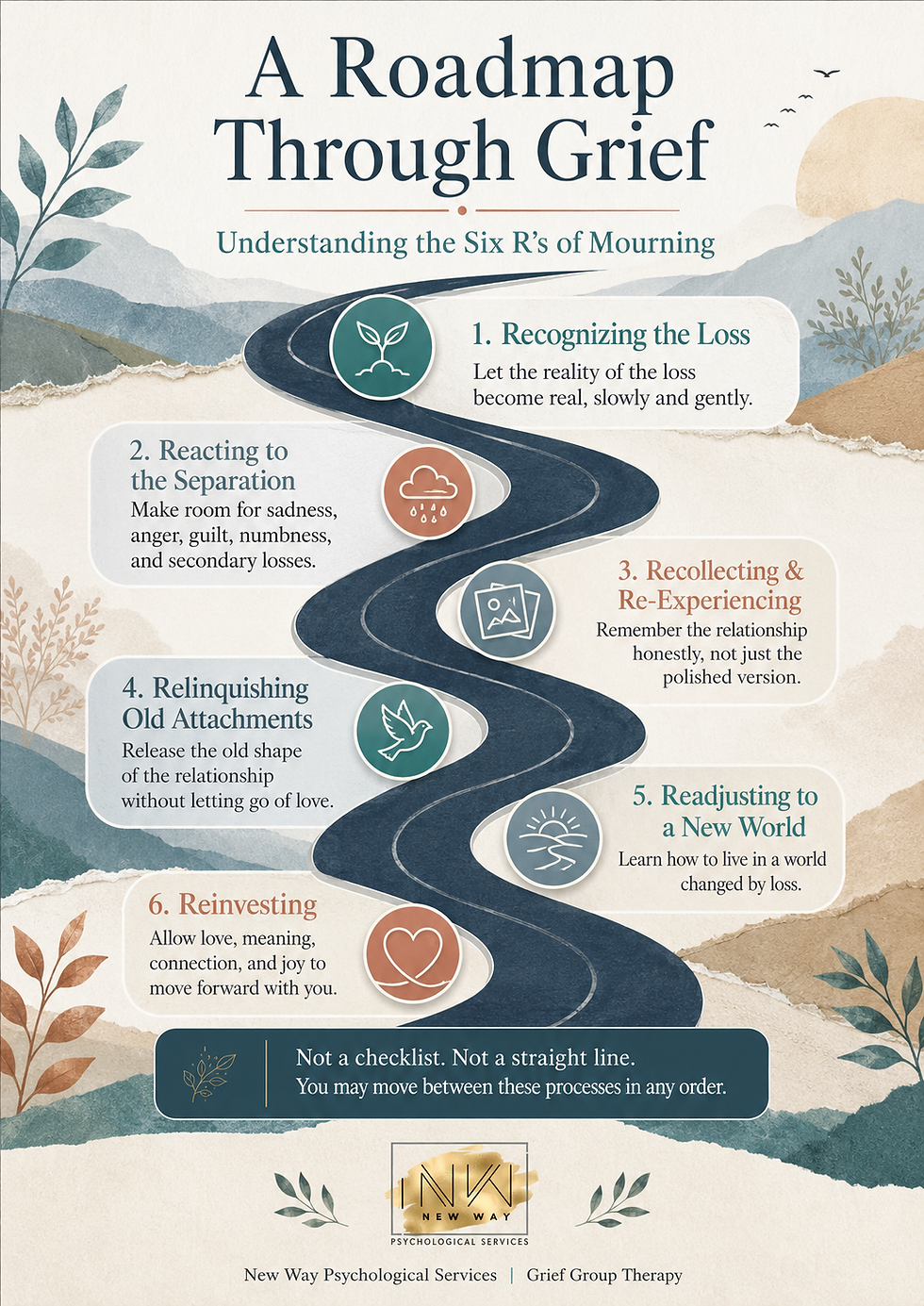
Recognizing the Loss
Before anything else in grief can happen, something basic has to occur. You have to let the loss actually be real, and that sounds a lot simpler than it is. Your mind is protective, and in the early days it will often shield you from the full weight of what happened. You might handle the calls and the arrangements while some part of you keeps the reality at arm’s length. You might reach for your phone to call someone who won’t answer. That’s not denial in any troubling sense. That’s your nervous system buying you time.
Recognizing the loss is the slow, sometimes painful shift from knowing something intellectually to actually feeling the truth of it in your body and your routine. It usually takes repeated contact with the loss before it fully lands, so be patient with yourself here. This one isn’t a moment. It’s a process.
Reacting to the Separation
Once the reality starts to register, the emotions show up, and they rarely arrive politely. Sadness, anger, guilt, relief, numbness, sometimes several of those in the same hour. Our culture tends to hand people a pretty narrow permission slip for grief. Sadness, sure, for a while. Anger, understandable, briefly. But grief that lingers past when other people are comfortable with it gets quietly discouraged.
This part of the process means refusing to shrink your grief down to fit someone else’s comfort. It also means noticing what Rando calls secondary losses, everything you lose because of the main loss. A friendship fading doesn’t just cost you the friendship. It costs you the specific way that person knew you, the inside references nobody else shares. Those secondary losses are real, and they deserve grief too.

Recollecting and Re-Experiencing
This is, in a lot of ways, the heart of grief work, and it’s the part everyday life gives the least room for. It means going back and remembering honestly, not just the comfortable, polished version of someone, but the whole of it. The habits that drove you a little crazy. The ordinary days you didn’t know were precious while you were living them.
Think about what happens at a funeral, when people stand up and tell stories about the person. That’s this process happening naturally, because people instinctively understand that grief asks you to go back and hold the relationship honestly before you can carry it differently. It’s connected to something called continuing bonds, the idea that we don’t detach from what we’ve lost so much as transform our relationship with it, and that transformation can’t happen without going back first.
Relinquishing Old Attachments
This is probably the most misunderstood part of the model, because the word relinquish sounds like letting go, and letting go sounds like forgetting. It isn’t either one.
Relinquishing means releasing the particular shape your relationship took, not the relationship itself. It might look like accepting that plans you made together aren’t happening. It might look like realizing a restaurant you always went to as a pair is somewhere you can go alone now, not because it stopped mattering, but because it can hold a different kind of meaning now. What you’re not giving up is the love, the memory, or the bond. You’re releasing the form it took while it was active. That’s a hard distinction to sit with, and it’s also the one that makes room for healing.
Readjusting to a New World
Loss changes the world you’re living in, practically as much as emotionally, and at some point grief asks you to figure out how to actually live there. Readjusting isn’t pretending the loss didn’t happen, and it isn’t going back to who you were before. That version of you isn’t coming back, and trying to force it is often what keeps people stuck.
It tends to start small. Trying something new. Going somewhere you haven’t been since the loss. Taking on something that used to belong to someone else. None of it is easy, and there will be moments it feels like betrayal. Let that feeling come anyway. It’s part of the process, not proof you’re headed the wrong way. There’s also an internal side to this. Who am I now that I’m not a spouse, or a caregiver, or someone in that job anymore. Those questions deserve real attention, and they’re exactly the kind of thing worth exploring with support.
Reinvesting
People are often the most afraid of this last one, because it can feel like it means something about forgetting or being disloyal. It doesn’t. Reinvesting emotional energy isn’t a betrayal or a replacement. It’s a continuation, choosing to let love and meaning keep moving through you, even now.
It might look like deepening a relationship that was already in your life. It might mean channeling what you’re carrying into something purposeful, or simply letting yourself feel joy again without immediately feeling guilty for it. This last process isn’t about closing a chapter. It’s about writing a new one while still honoring what came before. You carry the loss into whatever comes next. You’re not starting over. You’re continuing.
A Few Things Worth Knowing
These six aren’t a checklist you finish in order and then declare yourself healed. They’re closer to rooms you move between, sometimes forward, sometimes circling back to one you thought you’d already left. A song or a holiday can pull you back into recognizing the loss all over again, even years later, and that isn’t failure. That’s just what grief does.
The processes overlap too. You might be recollecting and readjusting in the same week. You might revisit relinquishing long after you thought that part was done. The model gives you language and orientation, not a rigid order, and honestly, that’s its real gift. Permission to be exactly where you are without judging yourself for it.
You Don’t Have to Map This Alone
Knowing where you are in your grief is one thing. Having a guided space to actually do the work in is something else entirely, and it makes a real difference. Our grief group at New Way Psychological Services is built around this exact framework, offering both clinical structure and the experience of being witnessed by other people who understand what loss actually does to a person.
You won’t be rushed, and you won’t be told where you should be by now. You’ll be met exactly where you are, and you’ll move through it in community, at a pace that respects what you’ve actually lost.


Comments